
What is Tensile Strength in Industrial Rubber Products?
By Richard Ramirez and Cody David, West American Rubber Company
Tensile strength is the maximum stress a cured rubber product can handle before it breaks.
High tensile strength rubber gets used anywhere a part is repeatedly stretched, flexed, or pulled under direct tension. Examples include seals, gaskets, vibration mounts, straps, diaphragms, and expansion joints.
Tensile Strength by Rubber Type
Values below reflect typical measures. Actual tensile strength for any given compound depends on formulation, filler loading, and cure systems as designated by the material specification.
| Rubber Type | Tensile Range (PSI) | Tensile Range (MPa) |
|---|---|---|
| Natural Rubber (NR) | 500 – 4,000 psi | 3.45 – 27.58 MPa |
| HNBR | 1,500 – 3,500 psi | 10.34 – 24.13 MPa |
| Nitrile (NBR) | 450 – 3,200 psi | 3.10 – 22.06 MPa |
| Neoprene (CR) | 450 – 3,200 psi | 3.10 – 22.06 MPa |
| Butyl (IIR) | 500 – 3,000 psi | 3.45 – 20.68 MPa |
| EPDM | 800 – 2,600 psi | 5.52 – 17.93 MPa |
| Fluorosilicone (FVMQ) | 200 – 1,500 psi | 1.38 – 10.34 MPa |
| FKM / Viton™ | 700 – 1,600 psi | 4.83 – 11.03 MPa |
| Silicone (VMQ) | 450 – 1,200 psi | 3.10 – 8.27 MPa |
With high elasticity, good compression, abrasion, and flex-cracking resistance, Natural Rubber is the first choice for many dynamic applications. HNBR is also worth consideration as it exhibits strong physical properties while adding the heat and chemical resistances that Natural Rubber doesn’t typically match.
On the lower end, materials such as FKM / Viton™, silicone and fluorosilicone are desired more for their extreme resistances across corrosive chemicals and wide temperature ranges rather than inherent dynamic properties including tensile strength.
How is Tensile Tested?
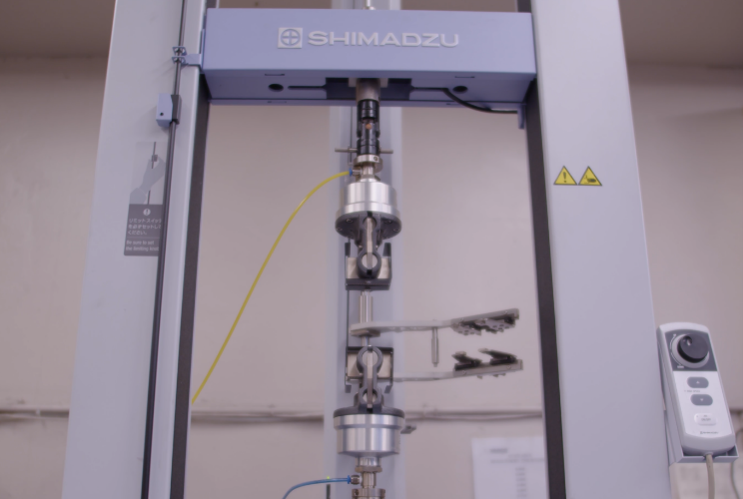
An industry standard test method for testing tensile is ASTM D412. This specification establishes the methodology for testing both tensile strength and elongation in industrial rubber products.
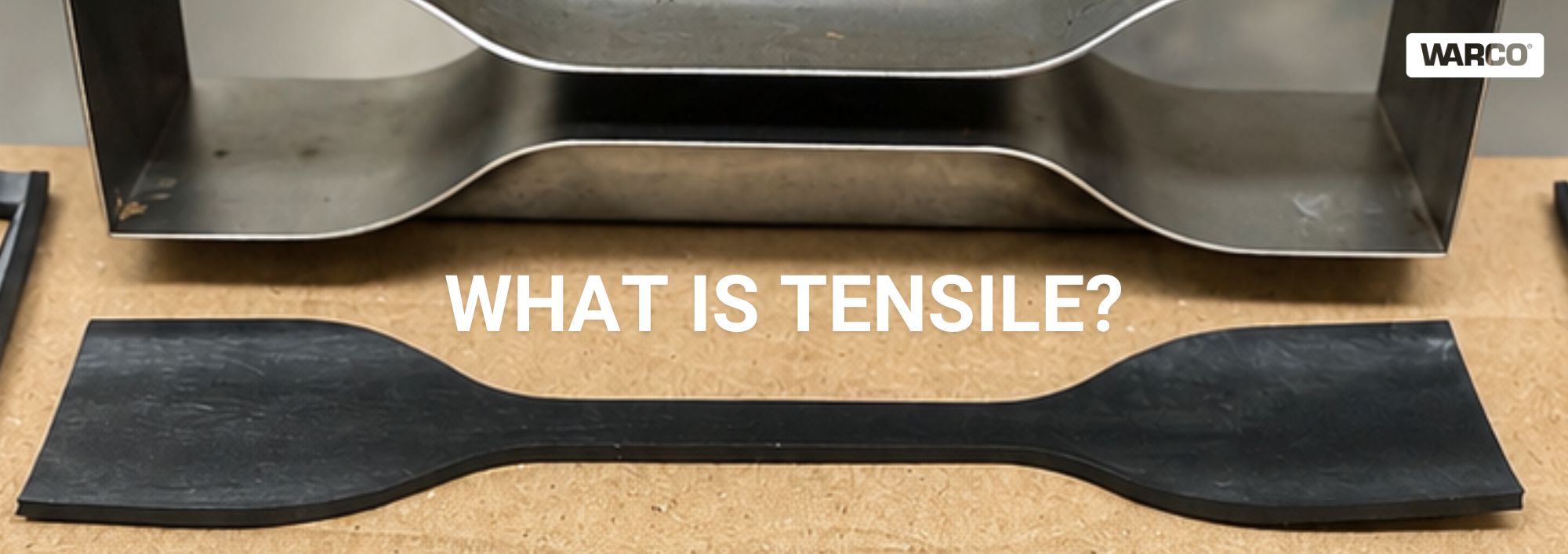
The test procedure requires a dumbbell-shaped sample (also known as a dog-bone sample) that is stretched on a tensometer until it breaks. The force required to break the sample defines the rubber compound’s tensile strength and the percentage of original length to how far it stretched at break defines its elongation.
Looking for High Tensile Rubber?
Established in 1910, WARCO is a USA manufacturer of high-performance, custom rubber parts for demanding industrial applications, including formulation and manufacturing of high-elongation rubber products.
Our in-house lab covers a wide range of testing to help you select the right material for your application. Questions about tensile strength and elongation for your specific use case? Reach our technical sales team at sales@warco.com or 714-532-3355.
Frequently Asked Questions (FAQs)
If you have any questions, email your questions to sales@warco.com, or contact us directly at (714) 532-3355.


