
What is Elongation in Industrial Rubber Products?
By Richard Ramirez and Cody David, West American Rubber Company
Elongation is the percentage a rubber product can stretch beyond its original length before it breaks.
It matters most in dynamic applications, anywhere a rubber part is repeatedly flexed or stretched. Higher elongation generally means better cycle life those applications, which is why you’ll see it specified for seals, pump parts, inflatable seals, expansion joints and other products under regular dynamic pressure.
Even a static application can benefit from high elongation if the part gets stretched or contorted during installation, as that stretch resistance is what keeps it from breaking before it ever gets to do its job.
How is Elongation Tested?
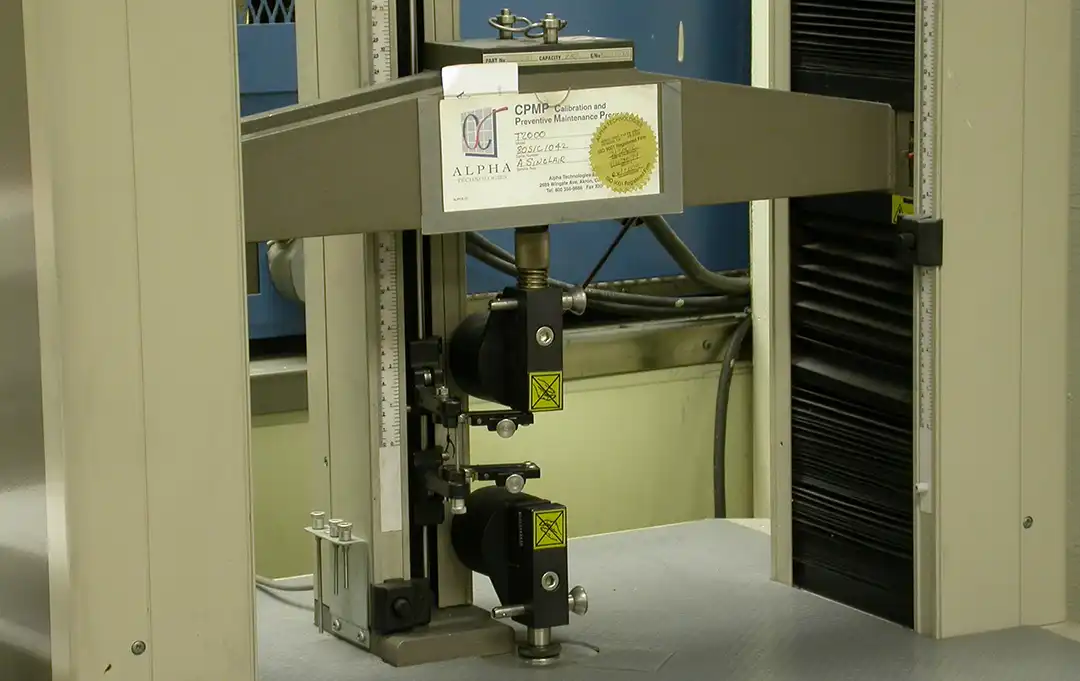
An industry standard for testing elongation is ASTM D412. This specification covers the methodology for testing both elongation and tensile strength in industrial rubber products.
The test uses a dog-bone-shaped sample, pulled by a tensiometer until it snaps. At the break point, the machine records both tensile strength and elongation at the same time. This is why elongation specifications are often written as “Ultimate Elongation at Break”.
Which Rubber Materials Have High Elongation?
Compounding can push elongation higher or lower across nearly any polymer, but Natural Rubber, Butyl, EPDM, Nitrile, and Neoprene are the materials with an established advantage.
| Natural Rubber | Butyl | Neoprene | EPDM | Nitrile (NBR, Buna-N) |
|---|---|---|---|---|
| 500% to 900% | 300% to 850% | 100% to 800% | 100% to 700% | 400% to 600% |
Looking for Rubber with High Elongation?
Established in 1910, WARCO is a 100% USA manufacturer of high-performance, custom rubber parts for demanding industrial applications, including formulation and manufacturing of high-elongation rubber products.
Our in-house lab covers a wide range of testing to help you select the right material for your application. Questions about elongation for your specific use case? Reach our technical sales team at sales@warco.com or 714-532-3355.
Frequently Asked Questions (FAQs)
If you have any questions, email your questions to sales@warco.com, or contact us directly at (714) 532-3355.


